
Why great programming beats technique every time (and how it gets you rebooked)
The #1 skill you need to master...

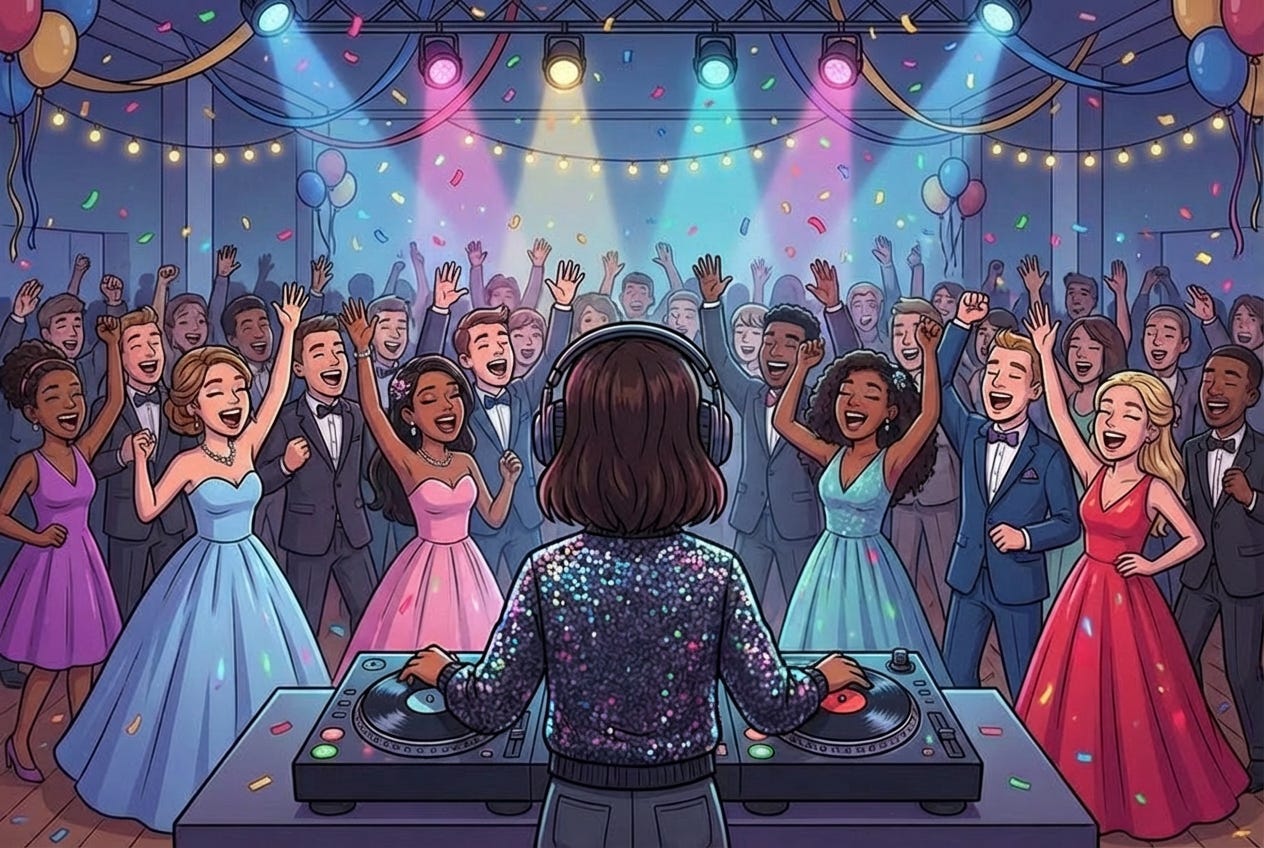
I just DJed a prom this past Saturday.
But I was nervous leading up to it.
As I get older, it gets a little harder to stay in touch with what the youth is connecting with. Tastes change. Music changes. And you have to put in a bit of work to see who is hot and what songs are working for the youth.
Now they did provide me a playlist. This helped a lot.
And it was incredibly surprising to review.
The The majority of the songs on the list came from the 90s, 2000s, and 2010s. Now mind you, most of the kids were probably born in the late 2000s/early 2010s.
I assumed (incorrectly) that most of my set would be hits from 2020-2025.
I could not have been more wrong.
What it took to get the crowd going
It took a moment to get everyone on the dance floor. They asked to start with the DaBaby’s “Pop That Thang” – which is a banger.
The floor got flooded immediately.
I kept the vibe going with some Drizzy that was in the same lane. And then we were off!
The requests that came in varied from 2000s reggaeton to 90s R&B to EDM to late 2000s club bangers to Mexican songs
It was all over the place. I played songs from the playlist, songs I knew would work, and the majority of requests that came in.
And it worked out just fine.
This made me wonder how did they know all this? Why are they resonating so hard with these songs?
I thought back to last week’s piece by Matthew Campbell. He wrote how you can structure a playlist based on a couple’s birth year, take that information, and extend that into who their crowd might be and how you can organize a set around that. It’s a very informative article and if you haven’t already, click here to read it.
And then it hit me.
The prom made me think about how they got exposed to these selections.
If Matthew’s theory about birth year connects to weddings, then there is only one answer to how these kids are turning up to songs they weren’t alive for when it came out.
Their parents.
Now that should be an obvious answer…
But it’s not.
Hear me out.
Growing up, you would go to your family friends’ houses and their parents would play certain music.
We know most kids don’t like to listen to the music their parents listen to. When my parents are listening to 90s adult contemporary R&B, I’m listening to Wu-Tang.
But their parents are probably in their early to late 40s. And they grew up on specific music from the late 90s through 2010s. So at these parties, guess who these kids were listening to…
Exactly.
Nostalgia definitely plays a role in what people like to listen to at parties.
On top of that, you still have to factor in that these kids are going to listen to what’s hot right now - specifically the younger rappers. The truth is Jay-Z doesn’t hit like DaBaby does. I love Hov, but every rapper has their moment. And DJs have to be well aware of this.
This idea can extend to other genres as well. EDM is huge, so Zedd will take precedence over Modjo. But it’s very possible that Modjo would land well on the dance floor.
I think programming is the skill that takes precedence over everything.
With this in mind, I think about set design. I’ve seen DJs who can’t mix and can’t scratch, but can program like no other. And the crowd was incredibly forgiving of the technical shortcomings because the song selections were so good.
Putting sets together does not have to be a complicated thing. You don’t need extra software for it. And even if you had a list of bangers, it doesn’t guarantee that you would be able to rock a crowd. Because you might not play the right songs at the right time.
Also, if you and I have the exact same playlist, we would organize it differently based on our experience.
What you do need to do is spend a little time thinking through what could work. You need to think about the past events you’ve been at. Observe which songs that have done wellwhich songs haven’t done well. With that data, work on creating sets, crates, and playlists that you can tap into while at gigs.
Your song selections and your programming ability are going to be the key thing that keeps you booked for future gigs.
But you need to start with your taste. Playing in front of crowds will sharpen your selection filter.
Think through what crowds get nostalgic for and what would hype them up.
Then test it out in different environments.
Note the response, adjust, and repeat.
The prom crowd didn’t know why they were losing their minds to a song from 2003. They just knew they were. My job was to know why before I ever showed up. That’s the whole game. Know your crowd, build your set around them, and the dance floor takes care of the rest.
As you continue to shut down each dance floor, your clients will take notice. They will ask you to come back. People will ask for your card. Repeat business follows.
To Your Success,
Shammy
If you’re serious about building a six-figure DJ business, consider getting a paid subscription. You’ll get the frameworks, systems, and strategies I use to book 100+ gigs a year at premium rates.
Paid subscribers get access to:
Weekly premium deep-dive posts with advanced tactics you won’t find anywhere else
Monthly live coaching call + Q&A for personalized guidance
Action templates & checklists to optimize your marketing, content, and bookings
If you’re ready to grow your DJ business with the proper support, this is where it starts.
Love this, and 100% agree. Song selection always wins over mixing skills. It starts with music, but mixing skills are becoming more desirable.